Controlled examples

Same evidence discipline.
Different professional problems.

These examples show how Epistamate behaved in controlled research and workflow experiments. They are not client case studies, comparative accuracy benchmarks or claims of universal superiority.

Consulting · synthetic specialist engagement

New evidence changed attention without silently rewriting advice.

A specialist advisory-method experiment tested what happens when new client material arrives after propositions, diagnostics, findings and recommendations already exist. The objective was not to replace the advisory method, but to see whether a governed workspace could preserve the causal chain between new evidence and affected work.
01 · Intake

Bounded attention

New material was represented locally and a priority review set was surfaced without discarding the lower-priority source content.

02 · Judgement

Explicit treatment

Uncertainty could become a clarification question; client answers returned as attributed evidence rather than informal memory.

03 · Impact

Causal propagation

Accepted evidence could affect proposition → diagnostic → finding → recommendation → deliverable in order, rather than rewriting the end state directly.

new material → bounded review → consultant treatment → clarification if needed → affected reasoning → recommendation / deliverable update
Research · document-led citation integrity

A reachable URL was not allowed to become evidence by default.

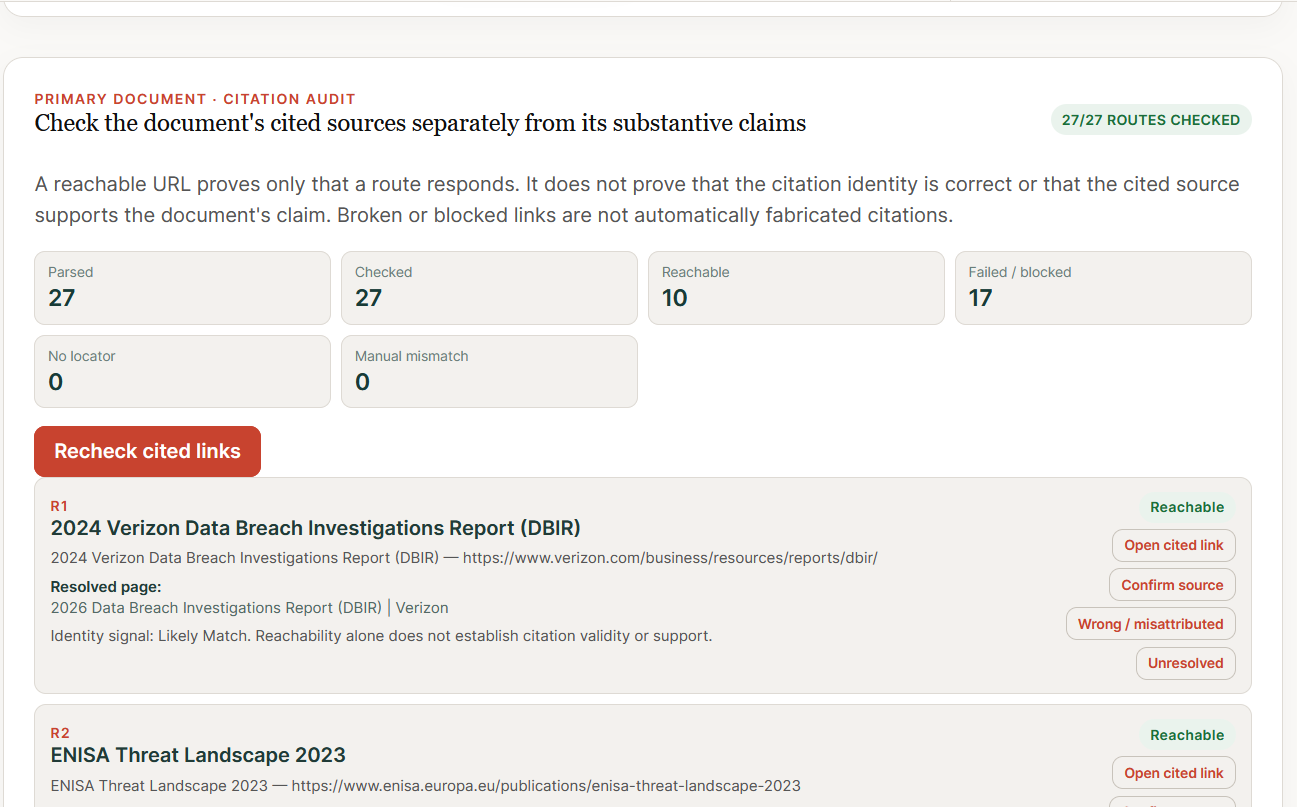
A supplied industry fraud/cyber paper contained 27 citations. Epistamate checked route reachability separately from citation identity, claim support and substantive validity instead of treating a working bibliography link as proof that the nearby claim was established.

Epistamate citation audit showing 27 cited routes checked, 10 reachable and 17 failed or blocked, with source identity reviewed separately from reachability.
1 · Citation routes were checked without being promoted to evidence. Epistamate recorded 27 route checks, including 10 reachable routes and 17 failures or blocks, while keeping citation identity and claim support as separate questions. A working route still required human review before it could carry evidentiary weight.
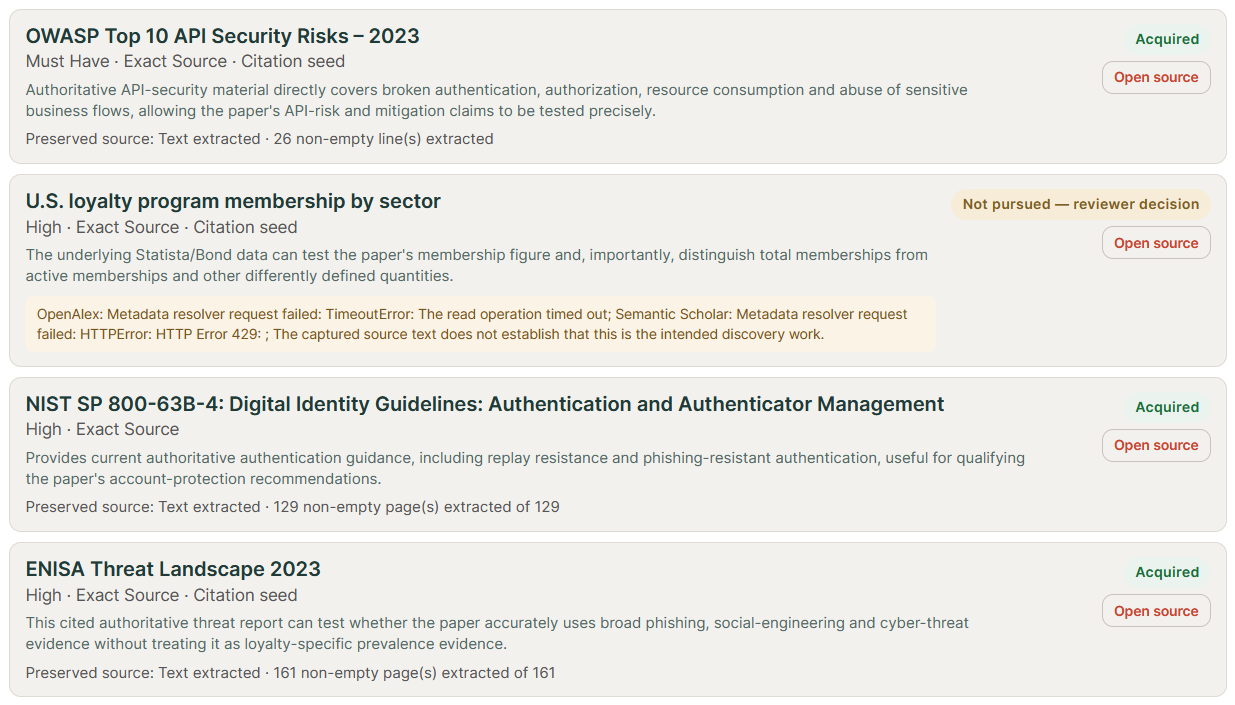
Epistamate governed research corpus showing acquired sources alongside an explicit reviewer decision not to pursue one source further.
2 · The usable corpus preserved both acquisitions and a deliberate limitation. Acquired source material remained inspectable alongside a target marked “not pursued — reviewer decision.” Epistamate preserved that choice rather than silently treating the corpus as complete; the researcher still had to decide whether the remaining limitation was acceptable for this run.
Citation integrity

Route ≠ support

A live URL could still resolve to the wrong edition or fail to support the nearby claim. Those questions remained separate review states.

Corpus construction

Repeated material did not become repeated corroboration

Preserved source contents were de-duplicated before later analysis so citation volume did not masquerade as evidentiary independence.

Question-led research

A second run tested continuing research state

On AI coding-assistant productivity, 14 planned targets produced 12 acquired sources while 11 knowledge gaps and 5 validation leads survived the first synthesis into the next iteration.

primary document → citation routes → identity / support review → preserved source contents → source-bounded claims → researcher-admitted research state
Policy · EU–India FTA

A trade agreement was not allowed to become the whole investment thesis.

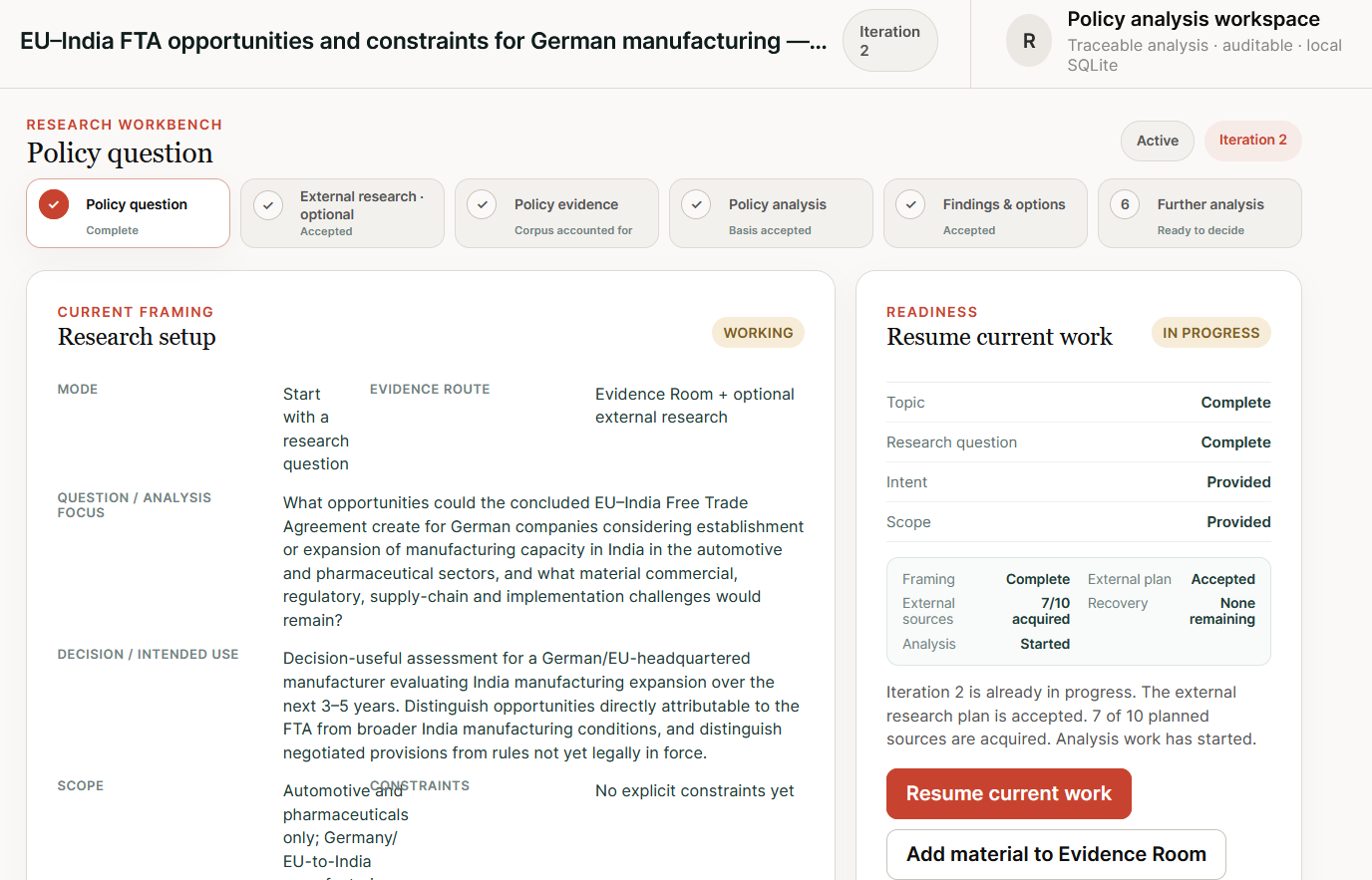
The policy/public-sector experiment assessed the concluded EU–India FTA for German/EU manufacturers considering India expansion over a 3–5 year horizon, focused on automotive and pharmaceuticals. The framing explicitly separated negotiated FTA effects from India’s broader market growth, industrial policy, regulation, FDI, logistics and state-level operating conditions.

Epistamate policy research framing for an EU–India FTA manufacturing assessment, showing the research question, intended use, scope and current iteration state.
1 · Start from the decision, not just the topic. The run defined the manufacturing decision, sectors, time horizon and intended use before analysis. It also required FTA-attributable effects to remain distinct from broader India manufacturing conditions. Epistamate preserved those boundaries; the researcher still owned the framing.
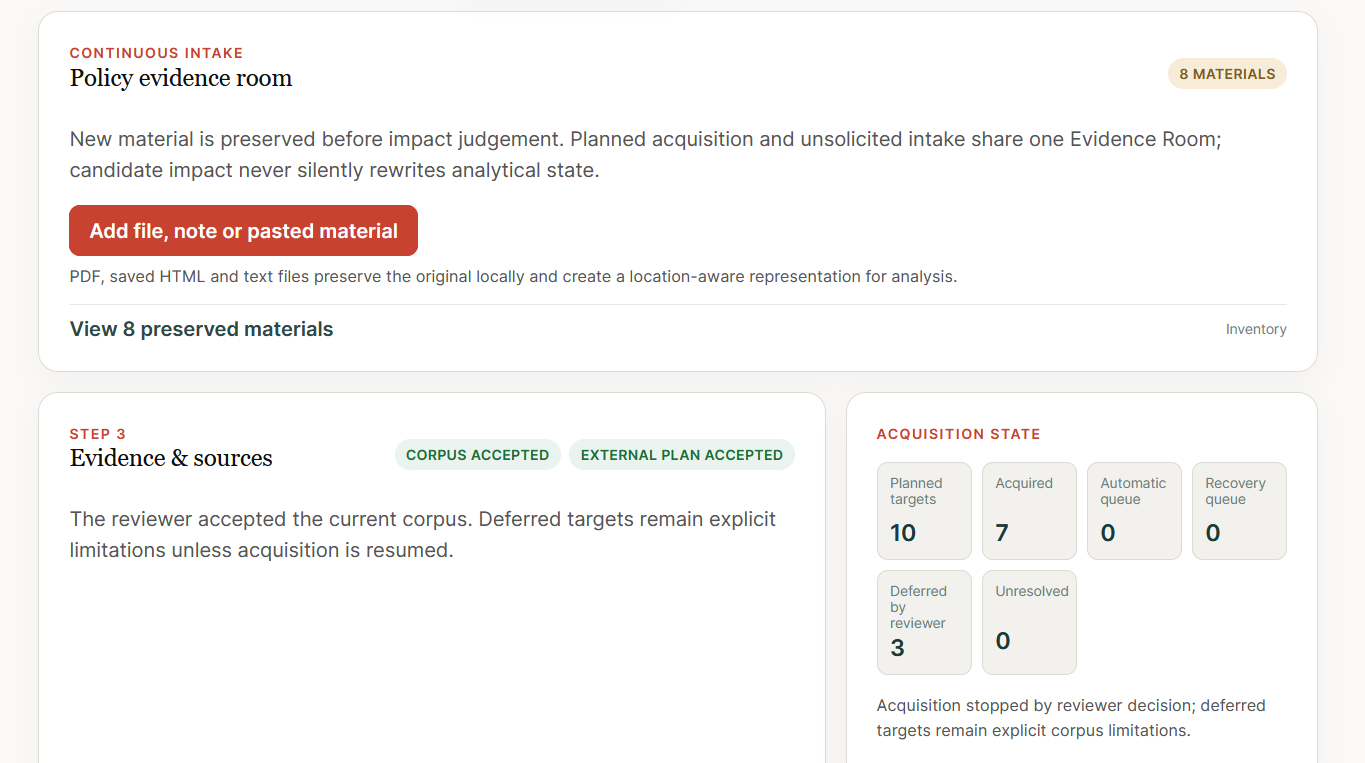
Epistamate policy Evidence Room showing 10 planned targets, 7 acquired, 3 deferred by reviewer and 0 unresolved.
2 · Incomplete acquisition remained explicit. Of 10 planned external targets, 7 were acquired and 3 were deliberately deferred by the reviewer, leaving 0 unresolved retrievals. Epistamate carried the deferred targets forward as corpus limitations rather than presenting the evidence base as complete.
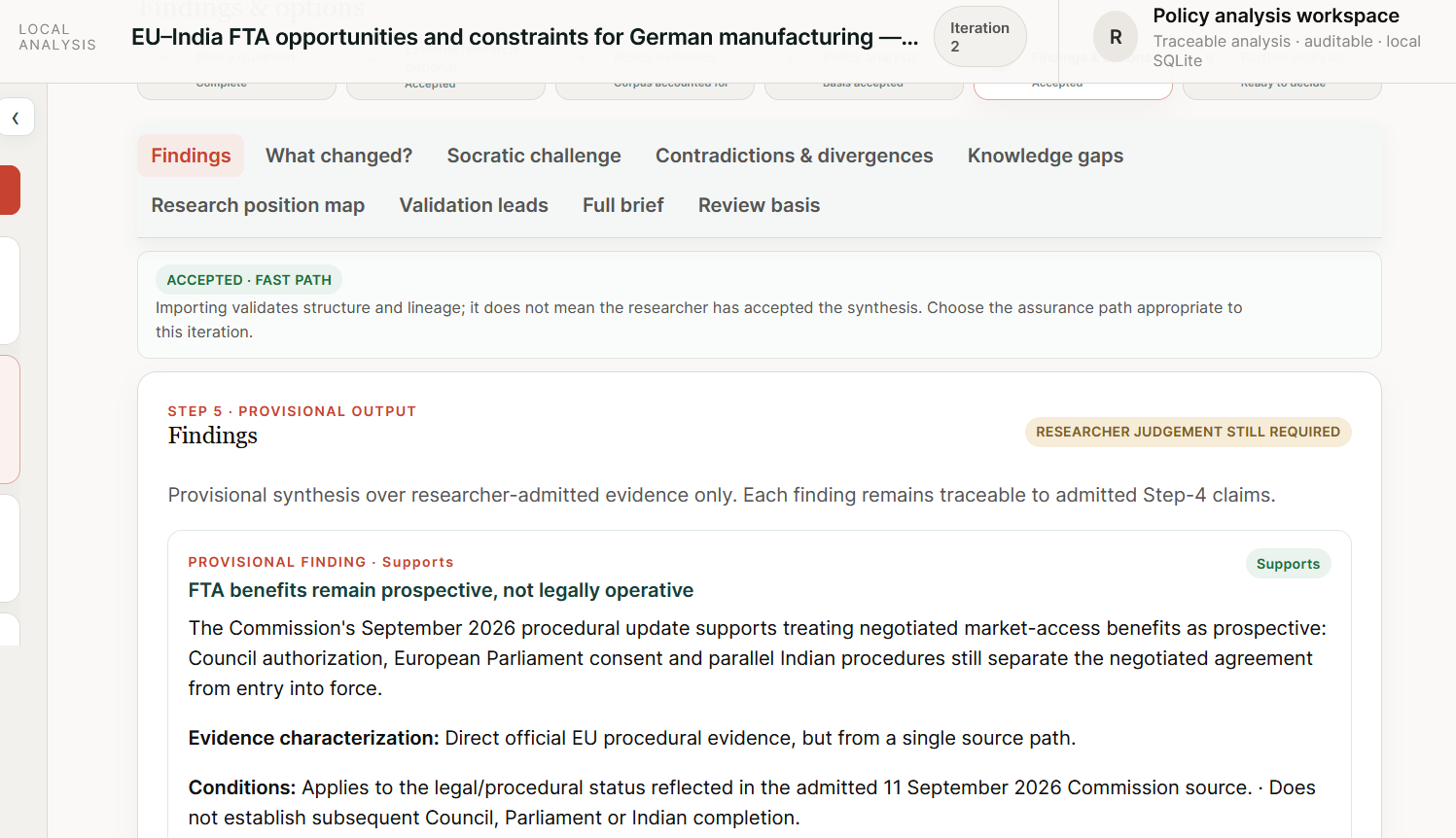
Epistamate provisional policy finding stating that EU–India FTA benefits remained prospective rather than legally operative, with researcher judgement still required.
3 · Negotiated opportunity was kept separate from legal effect. The provisional finding treated the FTA benefits as prospective because procedural steps still separated the negotiated agreement from entry into force. The interface also kept “researcher judgement still required” visible; Epistamate did not turn a provisional synthesis into an accepted policy conclusion.
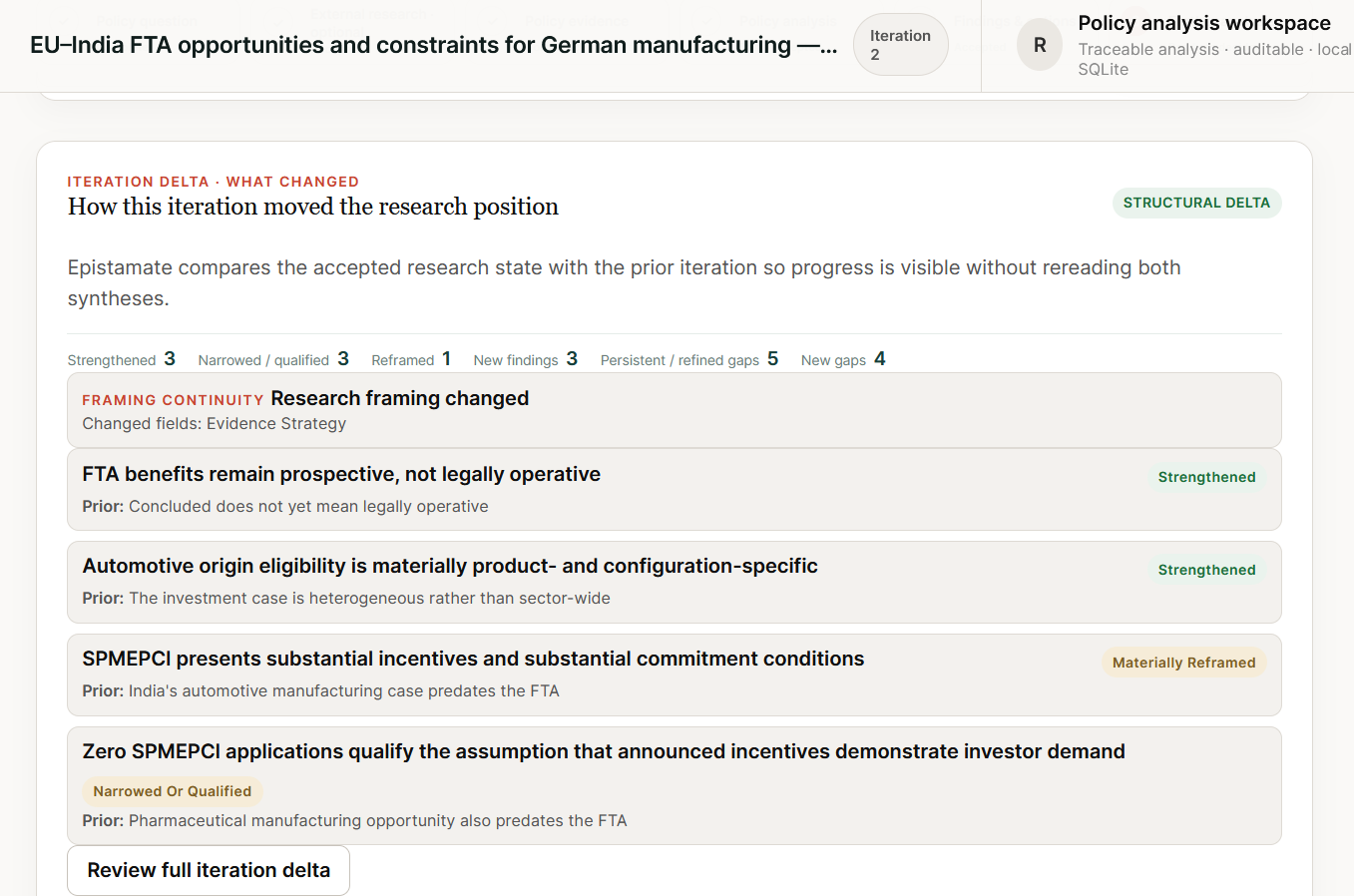
Epistamate policy research iteration delta showing strengthened, narrowed or qualified, reframed and new findings in an EU–India FTA research run.
4 · Iteration changed the research position visibly. Iteration 2 recorded what strengthened, narrowed or qualified, reframed, or appeared for the first time, while persistent and new gaps remained visible. The delta showed cumulative governed research rather than replacing the prior state with a fresh one-shot brief.
Automotive

Access depended on conditions

Tariff gains could not be read independently of quotas, phase-ins, classification and origin eligibility.

Pharmaceuticals

Tariffs were only one layer

Potential tariff savings coexisted with approval, pricing, regulatory and product-status constraints.

Strengthen iteration

New evidence changed the policy picture

The second iteration materially added rules-of-origin detail, evidence on zero uptake of the SPMEPCI scheme, pharma FDI material and firm-level manufacturing evidence while retaining major gaps.

Progressive coverage

The first model-facing pass was not treated as the whole corpus

Iteration 2 represented 2,168 passages. The first bounded pass analysed 67. The researcher then requested two non-overlapping 60-passage expansions, taking the admitted claim state from 27 to 43 and then 61. Later evidence mostly deepened an increasingly stable research position rather than creating a completeness claim.

FTA text / schedules → policy obligations → implementation status → sector conditions → bounded semantic passes over represented evidence → non-FTA India evidence → policy options / unresolved constraints
Regulatory · supplier terms

Contract language, law, guidance and standards were not treated as the same authority.

A regulatory/compliance experiment examined supplier terms from a leading IT-services provider against the surrounding legal and standards context. The central test was whether Epistamate could keep contractual assertions separate from binding law, official guidance, standards material and unresolved engagement facts.

Authority

Source roles stayed explicit

Binding law, official guidance, standards and contract language could all matter without being flattened into one confidence hierarchy.

Applicability

General relevance was not enough

A regulatory source could be authoritative and still require jurisdiction, role, service configuration or contractual facts before a conclusion applied.

Unresolved state

Missing facts remained visible

Unknown engagement facts stayed as explicit diligence needs rather than being filled by inference.

supplier terms → authority classification → external regulatory evidence → applicability checks → unresolved engagement facts → bounded compliance/review position

These examples describe controlled product behaviour and research state. They do not constitute legal advice, policy recommendations, audit opinions, client endorsements or quantified performance claims.